





How Minority Artisans Are Quietly Finding Their Place on India’s National Stage

When I walked into the India International Trade Fair this year, I expected the usual crowd, colours, food stalls, and a few impulse purchases. What I did not expect was a moment of clarity about how deeply handloom and handicraft traditions survive in the hands of India’s minority communities, particularly Muslims, and how meaningfully recent Government initiatives are helping them reach wider markets.
The first thing that caught my attention was the sheer number of Muslim artisans. They stood behind their stalls with the modesty and confidence of people who have lived with their craft since childhood. Some were young, some elderly, many from modest towns and villages, but all carried a certain dignity that comes from creating something entirely with one’s hands. What made their presence more significant was learning how they came here. According to officials at the venue, the Handicrafts and Handlooms Department of Kashmir, responding to a requisition by the Jammu & Kashmir Trade Promotion Organisation, finalised a list of 35 artisans and weavers through a transparent draw of lots. It was not an inner-circle selection, nor a symbolic representation. A process gave equal opportunity to anyone who had the skill and the courage to apply.
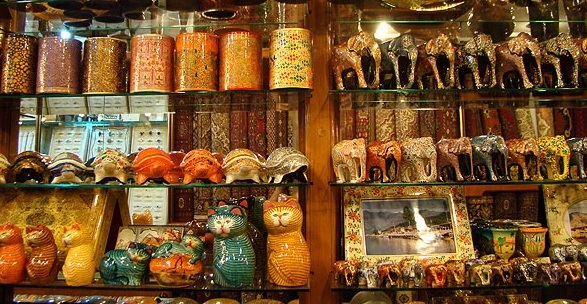
For artisans coming from regions where livelihoods are fragile and markets unpredictable, standing at a national trade fair is not merely a professional opportunity, it is a moment of recognition. For many artisans, this fair is more than a sales platform. It offers visibility that can change the economy of an entire family. In addition, importantly, it brings respect something that every artisan deserves, regardless of his or her background or community. As I moved from stall to stall, the richness of Kashmir’s craft tradition unfolded before me. Pashmina and Kani shawls that take months of labour, Sozni and Crewel embroidery carrying centuries of inherited skill, papier-mâché artwork painted with extraordinary precision, all of it displayed under warm yellow lights, drawing buyers from across India and abroad. It was heartening to see visitors asking questions, admiring textures, and understanding the effort behind each piece.
Muslim artisans from Uttar Pradesh, Punjab, Andhra Pradesh, Telangana, Madhya Pradesh, Maharashtra, Himachal Pradesh, and West Bengal stood in quiet strength, each bringing a regional identity shaped by local soil and tradition. From brassware and chikankari to bidri work, wooden crafts, ikat weaves, and intricate metal engraving, their stalls reflected how deeply Muslim artisanship is woven into India’s cultural geography. Different accents, different cultures, different histories, yet a shared language of skill, patience, and inheritance. It made the trade fair feel less like a marketplace and more like a living map of India’s plural heritage, where Muslim artisans were not confined to one region or one narrative, but were part of the national story in all its diversity. Muslim artistry expanded before my eyes, stretching far beyond.
As a Muslim woman observing all this, I felt a shift in perspective. We often hear that people from our community are left behind, or that their skills remain unrecognised. However, here, in the middle of a crowded Delhi exhibition ground, the picture was different. Muslim artisans were not silent or side lined; they were central, visible, and valued. Their work was being marketed, promoted, and celebrated not as minority art but as Indian heritage. It reminded me that empowerment does not always arrive with headlines. Often, it comes quietly, through fair selection processes, Government-backed platforms, subsidised stalls, artisan credit access, GI protection, training programmes, and the simple act of being given a stage large enough to be seen.
This year’s trade fair reinforced something I have often believed but seldom witnessed so clearly; when the Government invests in artisans, it strengthens not just an industry but also an entire social fabric. Handicrafts are not merely livelihoods; they are bridges between communities, identities, and histories. They hold stories that survive only when the hands that design them are supported. Moreover, when artisans, especially those from minority communities are offered that space, they fill it with beauty, skill, and a cultural depth that belongs to all of us.
Firdos Zakir Minda
Legal Expert and Journalist
Rajasthan High Court, Jaipur